基于多维多值概念格的矿山生产地学本体构建研究
作者简介:刘馨蕊(1984-),女,博士,讲师,研究方向为数字矿山、地学语义、知识管理和3S技术集成。E-mail: neu-lxr@163.com
收稿日期: 2017-05-23
要求修回日期: 2017-11-28
网络出版日期: 2018-03-02
基金资助
国家自然基金青年科学基金项目(71501036)
中央高校基本科研业务费资助项(N161404001)
Construction of Mine Production Geo-Ontology Based on Multi-dimensional and Many-valued Concept Lattices
Received date: 2017-05-23
Request revised date: 2017-11-28
Online published: 2018-03-02
Supported by
National Natural Science Foundation of China, No.71501036
The Fundamental Research Funds for the Cen tral University, No.N161404001
Copyright
矿山生产地学本体能够形式化描述领域概念,是实现多源异构信息集成与知识共享的关键技术之一。本文从多维地学数据源兼有同一性和特异性的视角入手,扩充多维多值概念格理论,构建兼顾全局和区域特性的地学境本协同语义模型与形式化描述,依托二者映射转换关系,提出强情境敏感性的多维地学结构化数据本体自动学习算法;并以金属矿山实际项目为例,结合矿山生产概念体系架构,构建矿山生产领域本体实例,验证方法有效性。该方法注重地学领多维特性,较客观地展示多维地学对象之间关联关系,且较顾忌局部区域时空等数据环境差异,有效提高矿山生产本体的构建效率与准确性,对其他地学领域本体构建提供借鉴。
刘馨蕊 , 张伟峰 . 基于多维多值概念格的矿山生产地学本体构建研究[J]. 地球信息科学学报, 2018 , 20(2) : 176 -185 . DOI: 10.12082/dqxxkx.2018.170234
Mine production includes geological survey and excavation, and is the fundamental activity for mine enterprise. Data related to mine production are typically geospatial, showing high space, temporal complexity and multi-scale. Geo-ontology can be applied to clearly describe and formalize geo-concepts, integrate heterogeneous geo-information and share geo-knowledge. However, several problems currently exist in the constructing process of using this new technique: efficiency resulting from extensive human involvement in the building process of geo-ontology, and the low accuracy from less attention for poor data quality and semantic contexts during data integration and knowledge reasoning. Moreover, the multiple relationships of the concepts are unclear as the multidimensional attributes and association patterns of geo-concepts are not sufficiently analyzed and expressed. The geological model and semantic descriptions are problematic without dynamic trajectories for moving objects and geological events. In this study, a new semi-automatic construction method of geo-ontology was proposed, regarding to geo-contexts based on a multi-dimensional and many-valued concept lattice (MDVCL). A formal concept hierarchy was automatically generated for higher efficiency using the multidimensional and many-valued concept lattice after data pre-processing and formal context creation of geodatabase. A semantic model of the geo-context-mediated ontologies (GMO) considering both global and local conditions was then constructed by adding four indexes of geo-contexts and dynamic events with OWL (Web Ontology Language) for more accurate formalizing description. The mapping rules were discussed between the concept lattices and the ontologies, and building mappings, in order to achieve straight forward semantic information from the concept lattices. In the end, a construction process was established through three steps, including knowledge pre-processing, multidimensional and many-valued concept lattices and semantic models. A metal mine containing geographic and geological data was selected to build a vein mining ontology for model verification. The results proved that this method could focus on multiple dimensions and complex backgrounds of the data, in order to reduce the risks of semantic errors, increase accuracy and efficiency of mine production, and provide important reference for other geo-ontology domains.
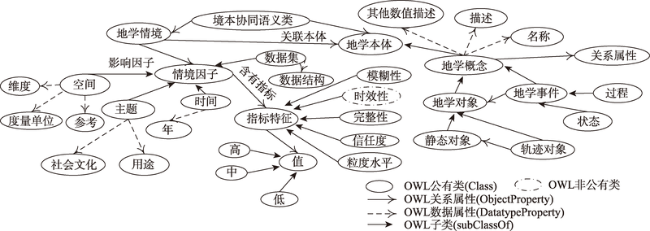
Fig. 1 The semantic framework of Geo-context and mediated ontology图1 地学情境本体协同语义架构 |
Fig. 2 Semantic structures of geocontext-mediated ontologies with OWL图2 基于OWL的地学境本协同语义结构 |
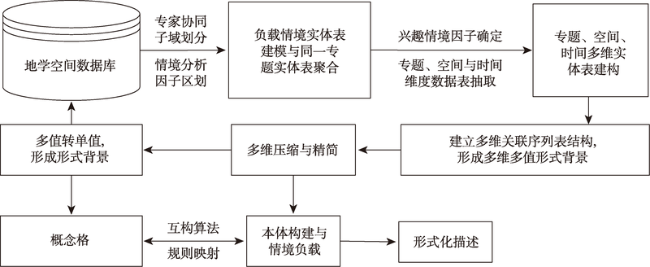
Fig. 3 Steps to build geo-ontologies using multi-dimensional and many-valued concept lattice图3 面向空间数据库和多维概念格的地学本体构建策略 |
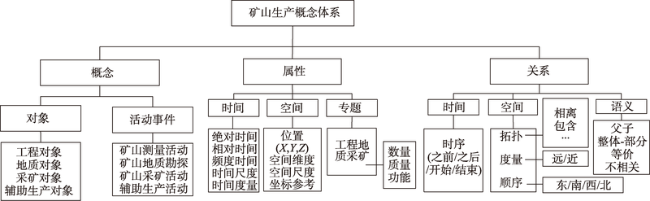
Fig. 4 Structures and elements of mine-production concepts图4 矿山生产概念体系结构 |
Tab. 1 An association list of a metal mine-production database(part)表1 矿山生产数据库关联表实例(部分) |
| 地质专题 | 采矿专题 | 工程空间专题 | ||||||||||
|---|---|---|---|---|---|---|---|---|---|---|---|---|
| 矿脉 | 矿体倾角/° | 矿体厚度/m | 岩层特性 | 空间关系(花岗斑岩脉) | 开采对象 | 工艺方法 | 工作区 | 年份 | 工程地点 | 工程对象 | ||
| m1 | 65 | 20 | 较稳固 | 相离 | m1 | 充填法和崩落法 | 一采区 | 2008 | 一采区 | m1 | ||
| m2 | 75 | 13 | 较稳固 | 相离 | m2 | 充填法和崩落法 | 一采区 | 2008 | 一采区 | m2 | ||
| m3 | 4 | 8 | 中等稳固 | 侵入 | m3 | 空场法和充填法 | 一采区 | 2008 | 一采区 | m3 | ||
| m4 | 57 | 10 | 较稳固 | 相离 | m4 | 充填法 | 一采区 | 2008 | 一采区 | m4 | ||
| m1 | 45 | 30 | 较稳固 | 侵入 | m 1 | 分段崩落法 | 二采区 | 2008 | 二采区 | m1 | ||
| m2 | 50 | 4 | 中等稳固 | 侵入 | m2 | 分段崩落法 | 二采区 | 2008 | 二采区 | m2 | ||
| m3 | 9 | 3 | 较差稳固 | 包含 | m3 | 充填法 | 二采区 | 2008 | 二采区 | m3 | ||
| m4 | 48 | 4 | 较差稳固 | 侵入 | m4 | 分段崩落法 | 二采区 | 2008 | 二采区 | m4 | ||
Tab. 2 An integrated and multi-dimensional table表2 多维聚合表 |
| 矿脉 | 地质(赋存条件) | 采矿(工艺) | 空间(采区) | |||||
|---|---|---|---|---|---|---|---|---|
| 矿体倾角 | 矿体厚度 | 岩层特性 | 空间关系 | 工艺方法 | 工程位置 | |||
| m1 | 急倾斜 | 厚矿体 | 较稳固 | 相离 | 充填法和崩落法 | 一采区 | ||
| m2 | 急倾斜 | 中厚矿体 | 较稳固 | 侵入 | 充填法和崩落法 | 一采区 | ||
| m3 | 微倾斜 | 中厚矿体 | 中等稳固 | 相离 | 空场法和充填法 | 一采区 | ||
| m4 | 急倾斜 | 中厚矿体 | 较稳固 | 相离 | 充填法 | 一采区 | ||
| m1 | 倾斜 | 厚矿体 | 较稳固 | 侵入 | 分段崩落法 | 二采区 | ||
| m2 | 倾斜 | 薄矿体 | 中等稳固 | 侵入 | 分段崩落法 | 二采区 | ||
| m3 | 缓倾斜 | 薄矿体 | 较差稳固 | 包含 | 充填法 | 二采区 | ||
| m4 | 倾斜 | 薄矿体 | 较差稳固 | 侵入 | 分段崩落法 | 二采区 | ||
Tab. 3 A multi-dimensional formal context表3 多维形式背景 |
| I | 空间位置a(一采区) | 空间位置b(二采区) | |||
|---|---|---|---|---|---|
| 赋存条件 | 采矿工艺 | 赋存条件 | 采矿工艺 | ||
| m1 | AHW(DC) | sq | BHW(PO) | x | |
| m2 | AGW(PO) | sq | BFX(PO) | x | |
| m3 | DGX(DC) | os | CFY(C) | s | |
| m4 | AGW(DC) | s | BFY(PO) | x | |
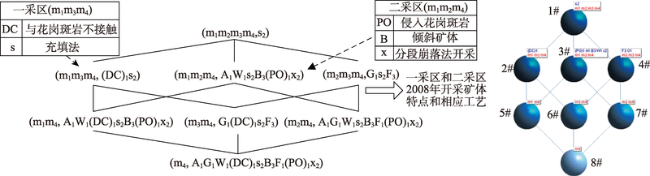
Fig. 5 A Hasse diagram and the transformed concept hierarchy model图5 对应的Hasse图以及转换后的概念层次模型 |
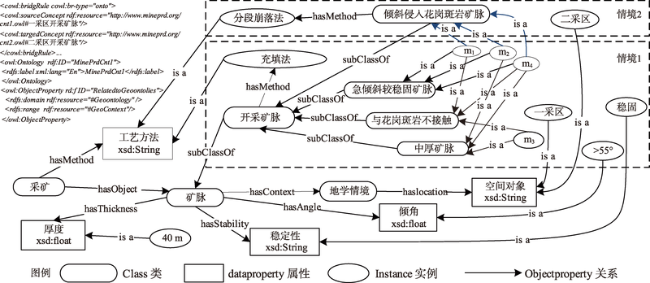
Fig. 6 Formal specifications for ore mining ontologies图6 矿脉开采本体形式化描述 |
The authors have declared that no competing interests exist.
| [1] |
[
|
| [2] |
[
|
| [3] |
[
|
| [4] |
[
|
| [5] |
[
|
| [6] |
[
|
| [7] |
[
|
| [8] |
[
|
| [9] |
[
|
| [10] |
|
| [11] |
[
|
| [12] |
[
|
| [13] |
[
|
| [14] |
[
|
| [15] |
[
|
| [16] |
[
|
| [17] |
[
|
| [18] |
|
| [19] |
|
| [20] |
|
| [21] |
[
|
| [22] |
[
|
| [23] |
|
| [24] |
[
|
| [25] |
[
|
/
| 〈 |
|
〉 |