基于历史相似案例空间推演的地震伤亡人口评估方法研究
|
曾婷婷(1995— ),女,福建泉州人,硕士生,主要从事灾害遥感研究。E-mail: zengtt@mail.bnu.edu.cn |
收稿日期: 2019-12-16
要求修回日期: 2020-03-15
网络出版日期: 2021-01-25
基金资助
国家重点研发计划课题(2017YFB0504102)
国家重点研发计划课题(2017YFC1502402)
国家自然科学基金项目(41671412)
版权
Study on Assessment Method of Earthquake Casualties based on Spatial Reasoning of Similarly Historical Cases
Received date: 2019-12-16
Request revised date: 2020-03-15
Online published: 2021-01-25
Supported by
National Key Research and Development Program of China(2017YFB0504102)
National Key Research and Development Program of China(2017YFC1502402)
National Natural Science Foundation of China(41671412)
Copyright
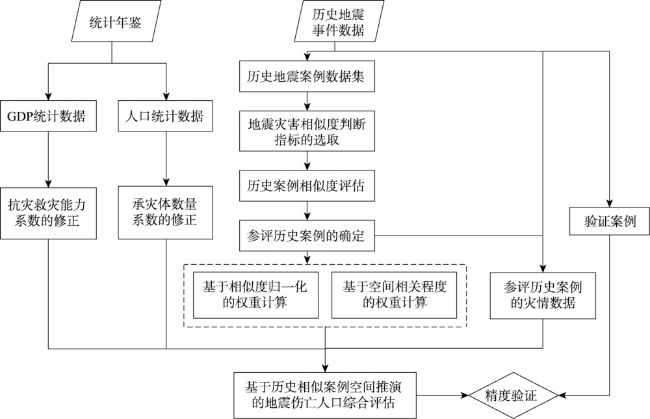
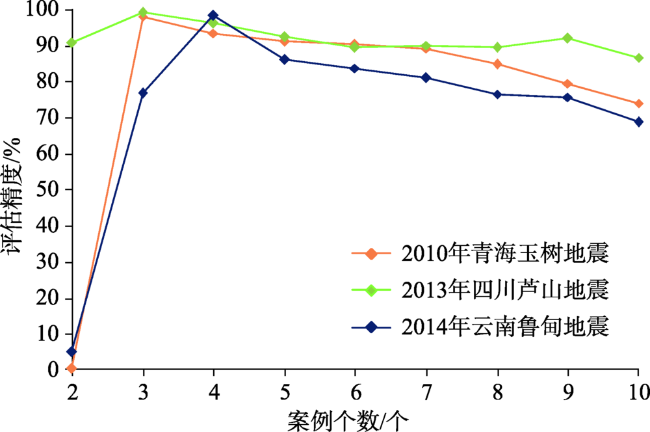
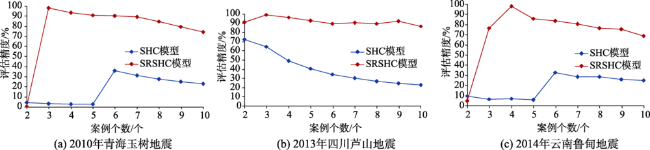
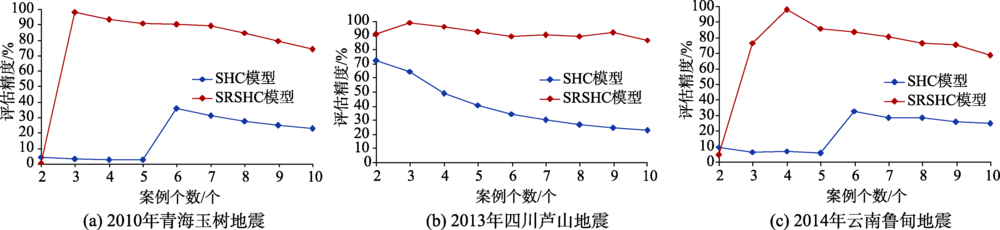
地震是对人类生存构成最大威胁的自然灾害之一,往往导致巨大的损失。本研究选取中国2000—2013年震级为4.0级以上且有人员伤亡的地震灾害统计数据作为历史案例,以基于历史案例的灾情加权综合评估模型(Assessment Method of Natural Disaster Based on Similarly Historical Cases,SHC)为基础,考虑历史案例与当前灾害的空间相关程度,获得改进的基于历史相似案例空间推演的地震伤亡人口评估(Assessment Method of Earthquake Casualties Based on Spatial Reasoning of Similarly Historical Cases,SRSHC);并选取2010年青海玉树地震、2013年四川芦山地震及2014年云南鲁甸地震作为验证案例,进行精度验证。结果表明:① 对于3个验证案例,SRSHC模型的最佳评估精度均在95%以上,表明该方法在地震伤亡人口评估方面具有一定的可行性及适用性;② SRSHC模型相较于SHC模型,参评案例的个数少且精度更高,以2010年四川芦山地震为例,当参评案例个数为3个时,SRSHC模型评估结果达到最佳(97.92%);而SHC模型参评案例个数需6个达到评估结果最佳(35.49%),这表明历史案例与当前灾害发生地区的空间相关程度对评估结果有较大影响;③ 灾情评估的精度与参评案例的个数有关,当参评案例在2个以上时,模型评估的精度随着参评案例个数的增加呈平稳下降趋势;当参评案例的个数为3~4个时,SRSHC模型的评估精度最佳。基于历史案例的灾情评估方法成本低、效率高、时效性强,且方法简单、约束条件较少、容易实现, 在灾情评估方面具有一定的实用价值。
曾婷婷 , 宫阿都 , 陈艳玲 , 杨雨晴 . 基于历史相似案例空间推演的地震伤亡人口评估方法研究[J]. 地球信息科学学报, 2020 , 22(11) : 2166 -2176 . DOI: 10.12082/dqxxkx.2020.190780
Earthquake is one of the most serious natural disasters for our human existence, and often causes huge losses. Disaster assessment based on similar historical cases is useful for disaster analysis and quick policy making when detailed real disaster data are not available. Based on the framework of the Assessment Method of Natural Disaster Based on Similarly Historical Cases (SHC model), this paper constructs the Spatial Reasoning of Similarly Historical Cases (SRSHC) model for earthquake casualty assessment, which considers the spatial relevance of historical cases to current disasters. We select earthquake magnitude, focal depth, and time of earthquake to describe the characteristics of an earthquake and use a similarity assessment model based on Manhattan distance to evaluate its similarity to historical cases. Besides, this paper introduces the distance of earthquake fault to quantify the spatial correlation between historical cases and current disaster. In this study, earthquake disasters with a magnitude of 4.0 or above in China from 2000 to 2013 are selected as historical cases. Three representative cases are chosen for accuracy verification, including the Yushu earthquake in Qinghai in 2010, the Lushan earthquake in Sichuan in 2013, and the Ludian earthquake in Yunnan in 2014. Results show that: (1) For the three verification cases, the accuracy of the SRSHC model is all above 95%, indicating that the model has certain feasibility and applicability in assessment of earthquake casualty; (2) Compared with the SHC model, the SRSHC model requires fewer participating cases but higher accuracy. For example, for the Yushu earthquake, when the number of participating cases is three, the accuracy of the SRSHC model reaches highest (97.92%). While the SHC model requires six participating cases to reach the highest accuracy (35.49%). It reveals that the spatial correlation between historical cases and the current disaster has a great impact on the evaluation of results; and (3) The accuracy of the disaster assessment model is related to the number of participating cases. When there are more than two participating cases, the accuracy of the model assessment decreases with increasing number of participating cases. When the number of participating cases is three or four, the accuracy of the SRSHC model is the highest. In conclusion, the advantages of the method developed this study are low cost, high efficiency, timely effectiveness, its simplicity, less constraint, and easy to implement, which has certain practical value and prospects in disaster assessment.
表1 2000—2013年中国大陆历史震例统计表(震级4.0级以上且有人员伤亡)Tab. 1 Statistics of historical earthquakes in mainland China from 2000 to 2013 (with a magnitude of 4.0 or above and casualties) |
| 伤亡人口数/人 | <10 | 10~50 | 50~100 | 100~500 | 500~1000 | >1000 |
|---|---|---|---|---|---|---|
| 历史震例数/个 | 8 | 14 | 4 | 10 | 6 | 8 |
表2 数据来源及用途Tab. 2 Data sources and uses |
| 数据 | 来源 | 用途 |
|---|---|---|
| 2000—2013年中国大陆4.0级以上 地震灾害统计数据 | 国家地震科学数据共享中心(http://data.earthquake.cn/gcywfl/index.html) | 提供地震震级、震源深度等地震信息参与计算案例相似度;提供历史案例的地震伤亡人数参与模型评估 |
| 2000—2013年中国各地区国内生产总值GDP | 中国统计年鉴(http://www.stats.gov.cn) | 计算抗灾减灾能力修正系数 |
| 2000—2013年中国各地区总人口数 | 中国统计年鉴(http://www.stats.gov.cn) | 计算承灾体数量修正系数 |
| 地震断层矢量数据 | 中国地震局地质研究所邓起东院士团队[27] | 计算地震震中位置与断层的空间距离 |
表3 地震案例相似度评估指标Tab. 3 Earthquake case similarity assessment index |
| 灾害指标 | 灾情指标 |
|---|---|
| 地震震级、震源深度、发震时间 | 地震伤亡人数 |
表4 SRSHC模型与SHC模型地震伤亡人口最佳评估结果Tab. 4 Results of the best assessment of SRSHC model and SHC model for earthquake casualties |
| 验证案例 | 实际伤亡人数/人 | SRSHC模型 | SHC模型 | ||
|---|---|---|---|---|---|
| 伤亡人数评估结果/人 | 精度/% | 伤亡人数评估结果/人 | 精度/% | ||
| 2010年青海玉树地震 | 14 425 | 14 725 | 97.92 | 5119 | 35.49 |
| 2013年四川芦山地震 | 11 687 | 11 830 | 98.78 | 8387 | 71.76 |
| 2014年云南鲁甸地震 | 3872 | 3799 | 98.11 | 1277 | 32.98 |
表5 SRSHC模型与SHC模型参与评估的历史案例(最佳评估结果)Tab. 5 The historical cases of SRSHC model and SHC model participating in evaluation (best evaluation results) |
| 验证案例 | 参与评估的历史案例 | |
|---|---|---|
| SRSHC模型 | SHC模型 | |
| 2010年青海玉树地震 | 2007年云南宁洱地震 2008年四川汶川地震 2008年四川青川余震 | 2008年青海大柴旦地震 2003年新疆巴楚地震 2007年云南宁洱地震 2003年新疆昭苏地震 2000年云南姚安地震 2008年四川汶川地震 |
| 2013年四川芦山地震 | 2010年青海玉树地震 2007年云南宁洱地震 2012年云南昭通地震 | 2010年青海玉树地震 2008年青海大柴旦地震 |
| 2014年云南鲁甸地震 | 2007年云南宁洱地震 2013年四川芦山地震 2003年甘肃民乐地震 2008年四川青川余震 | 2003年云南大姚地震 2012年新疆新源地震 2003年新疆岳普湖地震 2007年云南宁洱地震 2008年西藏当雄地震 2013年四川芦山地震 |
表6 不同参评案例个数的SRSHC模型和SHC模型灾情评估结果Tab. 6 Results of SRSHC Model and SHC model disaster assessment for different number of cases |
| 案例 个数 | SRSHC模型评估精度/% | SHC模型评估精度/% | ||||
|---|---|---|---|---|---|---|
| 2010年青海 玉树地震 | 2013年四川 芦山地震 | 2014年云南 鲁甸地震 | 2010年青海 玉树地震 | 2013年四川 芦山地震 | 2014年云南 鲁甸地震 | |
| 2 | 0.35 | 90.51 | 4.81 | 4.14 | 71.76 | 9.59 |
| 3 | 97.92 | 98.78 | 76.66 | 2.92 | 64.22 | 6.54 |
| 4 | 93.16 | 96.02 | 98.11 | 2.26 | 48.73 | 7.12 |
| 5 | 90.86 | 92.14 | 85.93 | 2.27 | 40.60 | 5.93 |
| 6 | 90.02 | 89.25 | 83.52 | 35.49 | 34.25 | 32.98 |
| 7 | 89.06 | 89.91 | 80.66 | 30.85 | 29.98 | 28.68 |
| 8 | 84.49 | 89.13 | 76.38 | 27.37 | 26.71 | 28.56 |
| 9 | 79.37 | 91.82 | 75.56 | 24.67 | 24.32 | 25.99 |
| 10 | 73.80 | 86.45 | 68.61 | 22.56 | 22.71 | 24.87 |
| [1] |
|
| [2] |
|
| [3] |
柏杨. 简支梁桥在地震激励下的扭转反应分析[D]. 哈尔滨:哈尔滨工业大学, 2011.
[
|
| [4] |
|
| [5] |
|
| [6] |
|
| [7] |
|
| [8] |
张莹, 郭红梅, 尹文刚, 等. 基于多因素的地震灾害人员伤亡评估模型研究[J]. 震灾防御技术, 2017,12(4):870-881.
[
|
| [9] |
肖光先. 地震工程中的经济问题[J].世界地震工程,1986(1):3-10,19.
[
|
| [10] |
程家喻, 杨喆. 评估地震人员伤亡的软件系统[J].地震地质,1996(4):462-470.
[
|
| [11] |
郑山锁, 张睿明, 陈飞, 等. 地震人员伤亡评估理论及应用研究[J]. 世界地震工程, 2019,35(1):87-96.
[
|
| [12] |
赵振东, 郑向远, 钟江荣, 等. 地震人员伤亡的动态评估[J]. 地震工程与工程振动, 1999,19(4):149-156.
[
|
| [13] |
赵振东, 郑向远. 唐山地震人员伤亡数值模拟与评估[J]. 地震工程与工程振动, 2006,26(3):28-30.
[
|
| [14] |
杨明儒. 地震压埋人员分布评估方法研究[D]. 哈尔滨:中国地震局工程力学研究所, 2014.
[
|
| [15] |
陈棋福, 陈凌. 利用国内生产总值和人口数据进行地震灾害损失预测评估[J].地震学报,1997(6):83-92.
[
|
| [16] |
王晓青, 丁香, 王龙 等. 四川汶川8级大地震灾害损失快速评估研究[J]. 地震学报, 2009,31(2):205-211,235.
[
|
| [17] |
|
| [18] |
丁香, 王晓青, 窦爱霞. 基于GIS的地震现场应急指挥管理信息系统研制[J]. 地震, 2014,34(3):160-170.
[
|
| [19] |
|
| [20] |
|
| [21] |
杨帆, 郑宝柱, 剡亮亮. 基于BP神经网络的地震伤亡人数评估体系研究[J]. 震灾防御技术, 2009,4(4):428-435.
[
|
| [22] |
于山, 王海霞, 马亚杰. 三层BP神经网络地震灾害人员伤亡预测模型[J]. 地震工程与工程振动, 2005,25(6):113-117.
[
|
| [23] |
周德红, 冯豪, 程乐棋, 等. 遗传算法优化的BP神经网络在地震死亡人数评估中的应用[J]. 安全与环境学报, 2017,17(6):2267-2272.
[
|
| [24] |
夏兴生, 朱秀芳, 潘耀忠, 等. 基于历史案例的自然灾害灾情评估方法研究[J]. 灾害学, 2016,31(1):219-225.
[
|
| [25] |
刘雅玉. 基于案例推理的台风灾害快速评估方法[D]. 武汉:武汉大学, 2018.
[
|
| [26] |
夏兴生, 朱秀芳, 潘耀忠, 等. 基于历史相似案例的农业旱灾灾情快速评估方法研究[J]. 北京师范大学学报(自然科学版), 2015,51(S1):77-81.
[
|
| [27] |
邓起东, 张培震, 冉勇康, 等. 中国活动构造与地震活动[J].地学前缘,2003(S1):66-73.
[
|
| [28] |
赵振东, 郑向远. 地震人员伤亡研究的回顾与进展[J].自然灾害学报,2000(1):93-99.
[
|
| [29] |
张莹, 尹文刚, 郭红梅, 等. 地震灾害人员伤亡关键影响因素指标体系构建[J]. 防灾减灾学报, 2017,33(4):87-94.
[
|
/
| 〈 |
|
〉 |